









Vitamin D3 and K2: Two Nutrients With a Shared Job
Why the sunshine vitamin needs a partner this autumn, and why the way you take it matters too.
As the clocks go back and the evenings draw in, vitamin D becomes a familiar autumn topic. In the UK, sunlight between October and early March is too weak for our skin to make meaningful amounts, which is why national guidance advises everyone to consider a daily vitamin D supplement through autumn and winter.1
Most of us know vitamin D helps keep bones and teeth healthy. Far fewer people have heard of its partner nutrient, vitamin K2. The two nutrients have different roles, but they come together around one important mineral: calcium.
Meet vitamin K2
Vitamin K comes in two main forms. K1, found in leafy greens, is best known for its role in blood clotting. K2 refers to a group of menaquinones produced by bacteria and found in fermented foods such as natto (fermented soya beans), some cheeses and egg yolks.
K2 is involved in the activation of vitamin K-dependent proteins found in bone and blood vessels. Natto is the richest source by far, yet it rarely appears on British plates, so dietary intake can be relatively low.
At a glance |
Vitamin D3 |
Vitamin K2 (MK-7) |
|---|---|---|
Main job |
Helps the body absorb and use calcium and phosphorus. |
Helps activate proteins involved in bone mineralisation and in limiting unwanted calcium build-up in blood vessels. |
Where it comes from |
Skin exposed to sunlight, oily fish, egg yolks |
Natto, some cheeses, egg yolks |
How well known? |
A household name |
Often overlooked |
How the partnership works
Think of calcium as a delivery. Vitamin D increases how much calcium the gut absorbs from food, so more parcels arrive in the bloodstream. It also supports the production of two important vitamin K-dependent proteins: osteocalcin, which is involved in bone mineralisation, and matrix Gla protein, or MGP, which helps limit unwanted calcium deposits in artery walls. Vitamin K is needed to activate both proteins.2
Here is the twist. Both proteins are made in an inactive form. They need vitamin K to undergo a process called carboxylation, which converts them into their functional form.
In simple terms, vitamin D helps increase the supply of calcium and regulates the proteins involved in handling it, while vitamin K helps activate those proteins.2 That is the basis for the interest in using vitamins D and K together.
The research behind this pairing is growing, although the evidence is not all of the same type.
In the Rotterdam Study, which followed over 4,800 adults for up to ten years, those with the highest dietary intake of K2 had a 57% lower risk of dying from coronary heart disease and less calcification of the aorta than those with the lowest intake.3
The findings are also relevant to bone health. In a three-year randomised trial of healthy postmenopausal women, those taking 180 micrograms of vitamin K2 (MK-7) daily showed less age-related decline in bone mineral density and bone strength than those taking a placebo.4
Just D3. Just K2. Just two sprays.
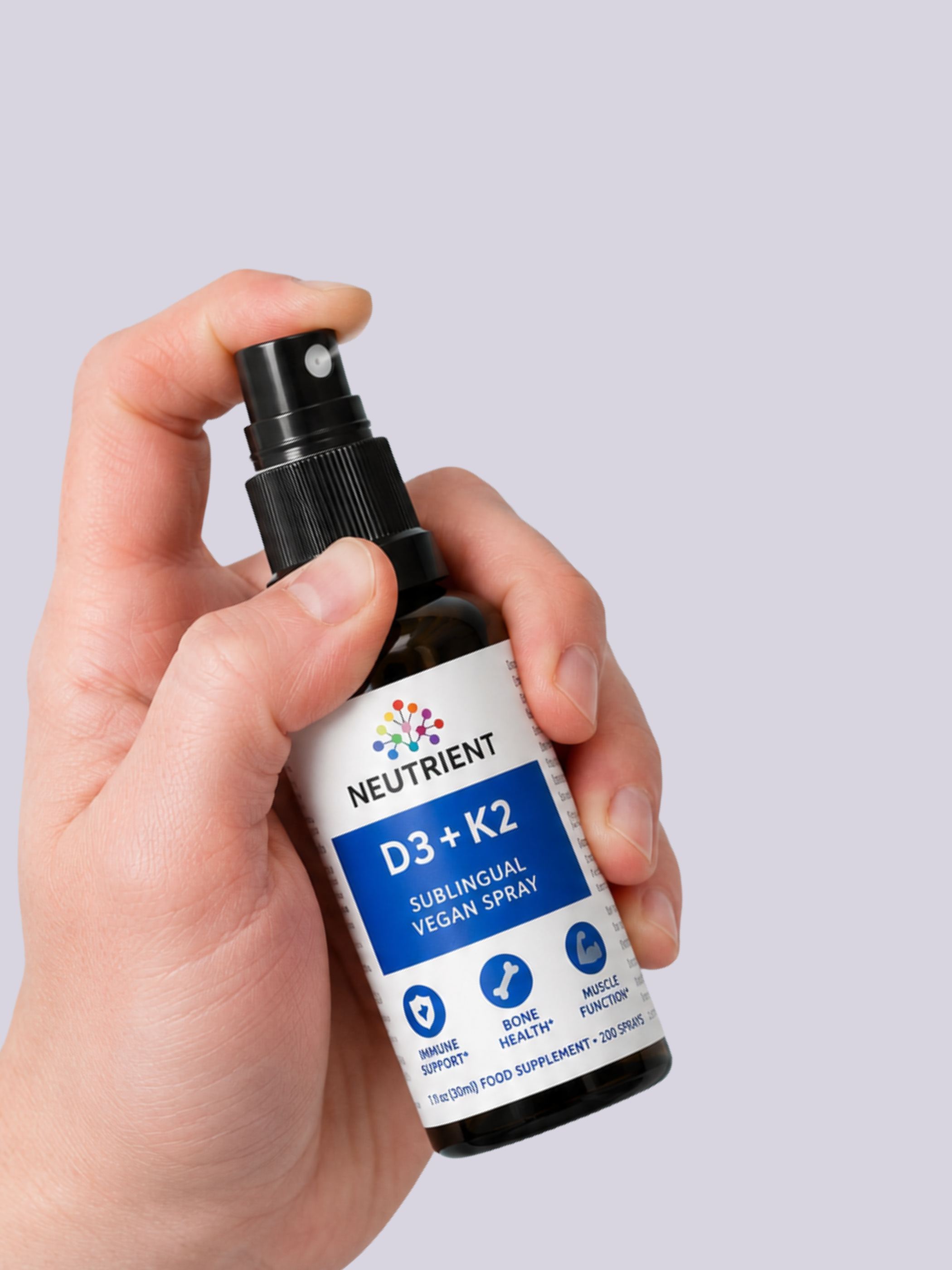
Neutrient D3+K2 keeps things refreshingly simple. Two sprays provide 50 micrograms (2000 IU) of vitamin D3 and 50 micrograms of vitamin K2 as MK-7, in a natural MCT oil carrier with vitamin E to help protect the formulation from oxidation.
Both vitamins are fat-soluble, making an oil-based formulation a practical choice. There are no sweeteners, flavourings, alcohol or glycerin, and it is suitable for vegans.
What each vitamin brings to the table
Vitamin D contributes to:
- normal absorption and use of calcium and phosphorus
- normal blood calcium levels
- the maintenance of normal bones, teeth and muscle function
- the normal function of the immune system
- plus, it has a role in the process of cell division
Vitamin K contributes to:
- normal blood clotting
- the maintenance of normal bones
Together, the two nutrients cover complementary aspects of calcium metabolism, while the spray format offers a simple way to take them as part of a daily routine.
That simplicity matters. Plenty of people dislike swallowing tablets, and one study of general practice patients found that over a third had difficulty doing so.5 Add a handful of daily capsules and it is easy to see why good intentions fade by November. A small spray bottle slips into a handbag, gym bag or desk drawer, and one bottle lasts around three months.
Oral spray |
Tablets and capsules |
|
|---|---|---|
Swallowing needed? |
No |
Yes |
Portability |
Pocket or handbag sized |
Tubs and blister packs |
Main absorption route |
Partly through the lining of the mouth |
Primarily absorbed through the gastrointestinal tract |
Timing |
Convenient to take at any time of day; avoid eating or drinking for 2–5 minutes afterwards |
Usually with a meal |
When absorption can't be taken for granted
Vitamin D from a capsule is absorbed through the small intestine. But what happens when gastrointestinal absorption is compromised?
People with Crohn's disease, ulcerative colitis or coeliac disease, and those who have undergone bariatric surgery, can be at greater risk of vitamin D deficiency because absorption may be reduced. Vitamin D deficiency is particularly common in people before and after bariatric surgery.6
A mouth spray offers a different delivery route. The tissue inside the mouth is thin and rich in blood vessels, so some of the vitamin D may be absorbed through the oral mucosa rather than relying entirely on intestinal absorption.
A randomised crossover study compared vitamin D3 given as a mouth spray with a standard soft-gel capsule in healthy adults and in patients with intestinal malabsorption, including people with ulcerative colitis and Crohn's disease. After 30 days, blood vitamin D increased by 10.46 ng/mL with the spray, compared with 3.96 ng/mL with the capsule in the malabsorption group.7 That is a substantial difference, although the study was relatively small.
A published case report describes a similar result in a patient with Crohn's disease and a new ileostomy, whose vitamin D deficiency was corrected using vitamin D given under the tongue.8
These are useful findings, but they are limited studies. The best dose and routine for people with Crohn's disease and other malabsorption conditions still need to be established. Anyone managing a gut condition should have their vitamin D status checked and monitored by their GP or specialist team.
What's new in the research
The established roles of vitamins D and K are only part of the story. Recent research is beginning to explore some less familiar effects, although these findings are still emerging and should be interpreted with appropriate caution.
A younger biological age?
Telomeres are protective caps on the ends of our chromosomes that shorten as we age. In a four-year analysis from the large US VITAL trial, adults taking 2000 IU of vitamin D3 daily had significantly less telomere shortening than those taking a placebo. The researchers estimated the difference in telomere length as equivalent to almost three years of age-related shortening.9 Interestingly, 2000 IU is the same amount found in a daily serving of Neutrient D3+K2.
Two sprays towards a brighter winter
Vitamin D rightly gets plenty of attention each autumn. Vitamin K2 brings a complementary role, helping activate proteins involved in bone mineralisation and the regulation of blood vessel calcification.
Together, they provide an interesting nutritional partnership around calcium metabolism, while a spray offers a simple alternative for people who find tablets difficult to swallow. For people whose gastrointestinal absorption cannot always be relied on, the delivery route may matter just as much as the nutrients themselves.
How to use Neutrient D3+K2
- Two sprays under the tongue or inside the cheek, once a day.
- Avoid eating or drinking for 2 to 5 minutes afterwards.
- Anyone taking anti-coagulant medication such as warfarin should consult their healthcare professional before taking vitamin K.
References
- Scientific Advisory Committee on Nutrition. Vitamin D and Health. London: Public Health England; 2016.
- van Ballegooijen AJ, Pilz S, Tomaschitz A, Grübler MR, Verheyen N. The synergistic interplay between vitamins D and K for bone and cardiovascular health: a narrative review. International Journal of Endocrinology. 2017;2017:7454376.
- Geleijnse JM, Vermeer C, Grobbee DE, et al. Dietary intake of menaquinone is associated with a reduced risk of coronary heart disease: the Rotterdam Study. Journal of Nutrition. 2004;134(11):3100-3105.
- Knapen MHJ, Drummen NE, Smit E, et al. Three-year low-dose menaquinone-7 supplementation helps decrease bone loss in healthy postmenopausal women. Osteoporosis International. 2013;24(9):2499-2507.
- Schiele JT, Quinzler R, Klimm HD, et al. Difficulties swallowing solid oral dosage forms in a general practice population: prevalence, causes, and relationship to dosage forms. European Journal of Clinical Pharmacology. 2013;69(4):937-948.
- Chakhtoura MT, Nakhoul NN, Shawwa K, et al. Hypovitaminosis D in bariatric surgery: a systematic review of observational studies. Metabolism. 2016;65(4):574-585.
- Satia MC, Mukim AG, Tibrewala KD, Bhavsar MS. A randomized two-way crossover study for comparison of absorption of vitamin D3 buccal spray and soft gelatin capsule formulation in healthy subjects and in patients with intestinal malabsorption. Nutrition Journal. 2015;14:114.
- McCullough P, Heaney R. Correction of vitamin D deficiency using sublingually administered vitamin D2 in a Crohn's disease patient with mal-absorption and a new ileostomy. Journal of Steroid Biochemistry and Molecular Biology. 2017;173:211-214.
- Zhu H, Manson JE, Cook NR, et al. Vitamin D3 and marine ω-3 fatty acids supplementation and leukocyte telomere length: 4-year findings from the VITamin D and OmegA-3 TriaL (VITAL) randomized controlled trial. American Journal of Clinical Nutrition. 2025;122(1):39-47.
Read more

Consider the woman in the garden, seventy-five years old, rising from a low deckchair without so much as a sigh, a groan, or the strategic deployment of both armrests. Her grandchildren find this u...
What happens beneath the surface when weight comes off quickly. GLP-1 medicines such as semaglutide and tirzepatide have changed the way many people approach weight loss and weight management. Much...